

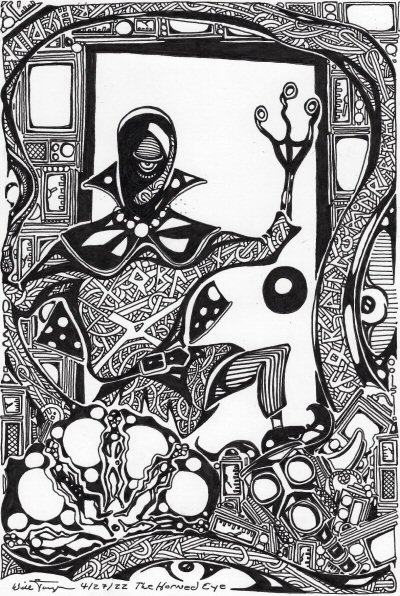
Artwork: The Horned Eye by Will Jacques
The Witch’s Song
Andrew Brenza
Claras left the safety of the understory to have a look around. They were compelled to. Through miles of dark forest, they had followed the remnants of a brutal scream to this very spot. Now, having arrived, they could feel the residue of its terror like a sludge in their mind. Claras was sure of it, something horrible had happened here.
Cautiously, Claras mounted a low ridge that overlooked the parched and pitted earth of a remote forest road. They also sprinted simultaneously to lookout points 20 meters to the north and 20 meters to the south of the ridge, fearful of being flanked or surrounded. But everything was quiet, still. Once in position, Claras was too.
Always careful, they waited. Minutes passed. Nothing stirred. It was strange. There was no activity in the forest. No creatures nosed around in the undergrowth. No birds sang in the canopy. Claras felt claustrophobic in the stillness, as though even the wind had been banished. Yet ostensibly nothing seemed amiss. Beyond the abnormal quiet, no strange sights, sounds or scents presented themselves.
This wasn’t what they had expected. In some ways, it was even worse than what they had expected. But Claras decided that they wouldn’t rush into anything. The earth was still loud with echoes of the scream, and they couldn’t shake its terror from their thoughts. Crouching low to the ground, hiding behind trunk or boulder, they continued to wait and to watch.
* * *
Hours earlier, while they foraged mushrooms in the dew-damp grass of a dawn-gray meadow, the scream had reached out to Claras through the mycelial network, battering the sensorium of their body. Its sudden arrival forced them to the ground, and they pawed at their ears and howled against the eviscerating intensity of its horror and pain. But Claras could determine neither cause nor owner of the cry, whether human or animal. There was only the brutal fact of it, emanating from a power fundamentally different in its cruel focus from the mainly misguided, though familiar, hatreds and prejudices of the ever-violent world around her.
It was this difference that had compelled Claras to investigate. It took some time, but the debilitating wave of horror eventually subsided and Claras regained their mind. Then, Claras began to run. The cry had burned itself like an afterimage into the mycelium, which made tracking easy, but frightening. Some hours later, wary but driven by the urgency of the cry, Claras arrived at the forest road, where they now waited, hiding, scanning for some sign of the evil that had brought them here.
But still, nothing stirred. Claras decided closer exploration was necessary. They dropped from the low ridge and landed lithely on the edge of the road. It was a quick and silent movement, after which Claras paused, alert for anything that might be waiting in ambush. When nothing occurred, Claras picked up a handful of dirt and raised it to their nose. Meanwhile, Claras’ flanks closed to within 10 meters of the ridge on either side, taut with fear and anticipation.
“Death,” thought Claras, throwing the handful of dirt to the ground with revulsion. “Bloody death.”
Suddenly, eight meters to the north, Claras also began to whine. Something had caught their eye. In an instant, all of Claras had converged on the position, four large black wolves and a humanoid figure wearing neatly fashioned deer skins. Two of the wolves kept watch on the road as the other two and the humanoid cautiously examined the area. The earth of the road was freshly torn like something large had swiped at it repeatedly. Additional disturbances of the landscape suggested a violent struggle. Claras did not recognize the tracks, but apart from them, nothing else presented itself as evidence. There were no bloodstains, no scattered belongings, nothing. Meanwhile, the surrounding forest remained disturbingly silent. One of the wolves noticed drag marks leading to the edge of the road, disappearing in the undergrowth.
Claras approached and, smelling nothing, stepped into the knee-high weeds. Drag marks gave way to trampled foliage, then, among a low tangle of vines, a haphazard pile of freshly shattered and splintered wood. Claras recognized the fragments as the broken components of a simple wooden horse-drawn cart, likely a farmer’s. The humanoid had seen such things when young, but not for many years. Since becoming Claras, the humanoid had successfully forsaken the world of Men. They had no plans to return.
Almost unrecognizable and perplexingly scentless, the splintered cart offered no additional information. However, the drag marks continued deeper into the forest. Cautiously, Claras followed them until they came to the hollow trunk of an enormous tree. Inside, still odorless, they saw the shadowy figures of three humans lying on the ground. They were motionless. Claras let out a low growl, but the bodies didn’t move. With a thought, the two wolves from the road were suddenly searching for tracks and for anything that might have been left behind. They spread out in concentric circles beginning two meters from the tree’s base. Meanwhile, the humanoid picked up a stick and poked the largest of the bodies, which looked to be a man. With a weird and sudden jerk, the body raised its left arm and then slammed it down on the ground. In an instant all four wolves were at the entrance of the hollow, growling at the body as the humanoid fell backward in surprise.
But soon Claras had regained their composure. In the minutes that passed, the body displayed no further signs of life and remained unresponsive to continued prodding. Sensing no immediate danger, the humanoid entered the hollow, while the four wolves watched on and whimpered nervously. Indeed, the body was that of a man. Placing a hand on the man’s chest, Claras noted with certainty that he was dead. But the naked body looked very strange, blackened, as though it were burned, but not charred, eyes hollowed out, skin taut, desiccated, and still no smell. The other two bodies, which Claras guessed to be the wife and child of the man, appeared much the same. Yet, despite the disfigurement, there was something familiar about the man’s sunken and mutilated visage. Claras felt that they had seen it before, a long time ago.
The face seemed to be from a time before the birth of Claras. To remember that far back was almost impossible. The integration of the five component minds that constituted Claras’ collective consciousness seemed to prevent it, and access to discrete memories that had formed in the pre-integrated minds had long since been cut off. Yet Claras, their vision fixed on the dead man’s face, began to see something emerge in the dark recesses of their networked imagination. At first, it rose vaguely, like a cloud, but after putting another hand on the man’s body, it began to resolve.
In the distance, as though Claras were looking through a tunnel, they saw overbright fields of corn and barley. They saw the half-melted façade of a shabby farmhouse located on a dirty smear of road. They heard the unintelligible voices of human children playing far away as though underwater. Yet, as they strained to look, the scene began to change. The sky, at first almost blindingly blue, began to darken. Soon it was night, and Claras watched a line of lights approaching through the blackness. The lights became the fires of torches, and the dark grew electric with anger and hatred. Twisted faces of men and women smothered Claras’ mind; bared teeth shouting with rage and a shadowy anger jerking in firelight plagued her thoughts. So many faces, so much hatred, they seemed to strangle Claras. Then long arms of shadow reached from the dark, gripping Claras’ throat, squeezing them, suffocating them, the darkness fading into liquid black. Breath became hard to grasp, and a bursting pressure mounted behind Claras’ eyes. More arms, more darkness. Then, revelation: A creature of opaque shadow and a thousand tentacle-like appendages. A creature with a thousand burning, yellow eyes and a mouth of flame and blood. A creature wrapped in and drinking Claras’ thought, Claras’s mind, Claras’ soul. A creature dragging Claras into nothingness.
Fear overwhelmed them. Claras tried to run, to break free from the creature’s asphyxiating grip. The creature overpowered them and dragged Claras deeper and deeper into the night. Soon the angry voices of the men and women were no longer audible. Soon their torch fires had been snuffed by indelible blackness. Desperately, struggling for breath, Claras tried to fight. They bit and clawed, but, in the black silence, they had no strength. It had all been leached from them. Claras fell, enervated, unable to move. Then, suddenly, like a door slamming, Claras’ mind snapped shut and they were gone.
* * *
Daylight. Quiet. A wolf’s warm tongue licking her face; a wolf’s snout sniffing her ears, the gentle comfort of his living breath. Then, unbearable isolation. Heartbreak. Sobbing. Tears.
“Noor. Noor,” she coughed between sobs, the involuntary word caught in her throat like a thorn. At the sound of it, the wolves ceased tending to her.
“Noor. Noor,” she was compelled to repeat, and the wolves withdrew. Pacing anxiously a few meters away, they whimpered and looked at her with uncertainty. But, lying on her side, she saw that there were only three of them. What had happened to the fourth, the largest and strongest of the pack? For reasons she couldn’t understand, the word “Njal” came to mind and, with it, more heartbreak.
In the effort to sit up, pain exploded through her weak body. She let out a cry that frightened the wolves. In an instant, they fled into the forest and were gone. She couldn’t believe it. She tried to call them back but could not find them in her mind. In fact, there was no trace of them. There was only her strange, lonely and broken self. She hardly recognized it as she collapsed in sobs, crying deeply, beseeching Claras’ return. But Claras, who was never lonely and never alone, was gone. But Claras, who was always protected and held, was no more.
“Noor. Noor,” she said again to herself. Except this time the word emerged from her mouth intentionally. Now, she remembered its meaning. Noor was her. Noor was her name. It hurt her to recall this. Sorrows from her distant past flitted through her mind and she winced from the pain. The memories were sharp and vivid.
But the recent past was cloudy and vague. She could recall only a vague attack of some kind, and the blackened bodies in the hollow of a tree. A lightning bolt of fear and alarm shot down her spine. “I may still be in danger,” she realized. This time, suppressing a cry of pain, Noor sat quickly up and looked around.
Seeing no immediate danger, her attention moved to the pain in her body. Her limbs throbbed with soreness. She looked at her hands and arms for injuries. Though free of open wounds, Noor saw that her skin was splotched and streaked with livid and gangrenous stains, similar to the markings on the bodies she had examined, but less pronounced. Pulling up the legs of her pants, she saw the same markings on her feet and shins. She felt physically drained and utterly vulnerable. The markings frightened and sickened her.
But what had happened? Noor saw she was no longer at the mouth of the hollow tree, but some 15 meters away. Had she gotten here under her own power? Had the wolves pulled her? She couldn’t recall. Perhaps there were clues, if not answers, at the hollow tree.
Gathering her strength, she attempted to stand but failed. Noor was simply too weak, too beat up, to walk. Instead, she crawled. It took some time, but eventually she reached the hollow of the tree, panting and out of breath. Yet, the area did not look familiar. In fact, it looked as if an explosion had occurred inside the tree hollow, blackening the tree’s bark and scorching the surrounding foliage. Noor crawled to the entrance of the hollow and peered inside. The grotesquely twisted bodies of the humans had been blown to the walls. But there was more. A misshapen lump of black fur lay in the middle of the scorched bower, lifeless and still.
Noor, suppressing tears, crawled towards it. As soon as her hands touched the rough and tattered fur, she knew. It was Njal, the largest of the wolves in the pack. At once, the names of the other wolves flooded her mind: Petra, the mother wolf, and her children with Njal, Svend and Bard. The names felt strange and foreign. It had been a long time since any of them had come into her consciousness. Claras had had no use for them.
But she was Claras no longer. Feeling the full weight of this change, this loss, in addition to the death of Njal, Noor buried her face into the remaining fur of her old friend and wept. She wept and wept, no longer caring if she were in danger, for she knew that somehow Njal had saved her, had given his life for hers, and it shattered her. The union had been broken. And now, she was alone, so terribly alone that she wished she had died, too. But instead, she wept. She wept and wept until darkness came and she fell asleep.
* * *
It was still dark when Noor awoke. A gentle wind had returned, causing the blue light of a full moon to dance and pool at the entrance of the hollow. Inside the tree, it was dark, but Noor could still see the outline of Njal’s body, a vague and crumpled mass, lying motionless on the ground. She resolved to bury him as soon as the sun rose. In the meantime, she would sort things out.
To her surprise, she felt refreshed. Much of her strength had returned and she was able to stand and walk with little effort. For some time, she stood at the entrance of the hollow listening to the night air. She was grateful for the return of life to the forest. Crickets and katydids chirped from the branches of the surrounding trees. Fireflies sparked here and there. Bats zipped and zagged, feeding on invisible insects. It made her feel less alone.
In time, her mind returned to the events of the previous day. Noor was certain the shadow beast was responsible for the death of the farmer and his family, for the death of Njal, and for the death of Claras. She wondered if Claras had, in fact, been targeted by the beast or if some other agent had brought Claras there to fight it. Perhaps, she thought to herself, it was just dumb luck that led me here. Whatever the truth, Noor could not remember the events clearly enough to form a strong opinion either way. Regardless, she now felt certain of one thing: She would destroy the beast or die trying.
Yes, destroy the beast. She had to. But the realization immediately led Noor to two other concerns: One, where would she even begin to look for it? Two, even if she could find it, how would she go about killing it, assuming it could be killed?
As these questions rattled unanswered in her skull, Noor pressed her fingers into the earth. The movement was habitual but, eventually, her awareness registered the coolness of the ground lingering a few inches below the service. It drew her attention downward, and she looked at her half-buried hand with curiosity. What am I doing? she thought. She couldn’t say for sure. Yet she had a vague notion that she was seeking guidance. She was also dimly aware the action had helped her in the past. But now, even though it seemed to be on the tip of her tongue, she could not say just how or why it had been of use. She felt angry.
The vagueness of her memories. The cloudiness of her mind. They brought Noor to the brink of screaming with frustration-induced rage. So much of herself now seemed either hidden from her awareness or was gone for good. Whatever the case, she felt certain that, in addition to the death of the beast, she now had to restore herself, preferably as Claras, but even Noor would do. Anything would be better than this nebulous state of uncertainty.
Soon the sun was beginning to rise. Noor found a shaded place beside a large boulder, protected by a wild hedge of bramble. It was here that she began to dig a grave for her friend. The work was hard, but as she scraped the parched earth with a flat stone, something happened. Something dislodged in her, and memories of her younger years began to enter her mind. Dim at first, the memories grew in clarity with each passage of the stone. Soon, they danced in her awareness, vivid as dreams.
Noor saw a young girl living alone with her mother on the outskirts of a scrawny village, in a hovel at the edge of a deep forest. She saw the young girl’s loneliness and sadness, and she felt the loathing which surrounded her. For girl and mother bore a vegetable strangeness like moss in their hair. Like grass stains on their hands, it marked them, and they were hated for it.
Noor watched with sorrow as the young girl, scavenging fungi for her mother from the village midden, was driven off by a gang of children who pelted her with stones. Noor watched as the young girl, wearing rags, was chased from fields of golden wheat, the farmers’ faces twisted in snarling rage. She watched as the young girl, lurking in the shadows of night, observed the village from afar, envious of the warm lights in the cottage windows, yearning for inclusion in the distant sounds of human conversation.
But their vegetable strangeness was also their power. And the village hatred always lasted only for as long as girl and mother were not needed. Digging deeper into the earth with her flat stone, Noor recalled the timid, desperate, anger-edged knocking on the hovel door. She remembered women standing in the dark doorway, tears gleaming in the candlelight, tears of anger, of despair, of fear. Noor remembered white-fisted men, disgusted but beseeching, growling resentfully, pitifully, for her mother’s care.
And her mother always helped them. Though embittered by the need to hear her mother’s words, by the sounds of her mother’s song, the townsfolk always left with a sachet or a vial of their shame in their pockets, medicine for some feverish child at the edge of death or an ointment for a farmer’s broken and infected leg.
Such was the tenuous but frightening peace of Noor’s childhood. The townsfolk detested Noor and her mother, but they were needed. So, the hovel never burned. Rather, it stood, half-shrouded beneath the trees that grew like sentries around it, balanced on fingers of moss. In time, Noor’s mother taught Noor the magic of her song, the song that Noor’s mother had learned from her mother, the song that Noor’s ancestors had always sung, the song of their power.
But one night the song failed Noor. One night, she awoke to find vines crawling from her mother’s mouth and roots growing out her mother’s ears. Tendrils coursed under her mother’s skin and pierced her mother’s eyes. For over her stood a white-fisted man with blood on his shirt and hands. He bore the face of the blackened farmer, though ashen now with living rage. Noor’s throat, dry as silence, could not sing a single note of the song then, could not shout or scream or cry a single note as the first torch broke through the window and landed on the wooden floor, setting the floorboards ablaze.
But, to Noor’s astonishment, rather than burn, the hovel opened. The floorboards fell away, revealing a pit that swallowed Noor’s mother in a reeking mass of vines and dirt along with the murderous farmer and the flames. Yet still, the townsfolk approached. Their hatred had overcome their fear, and torch after torch sailed through the open window and doorway. Soon the walls of the hovel were aflame, and Noor retreated to a small bedroom at the back of her home. The smoke and flames followed her, and she panicked. Moving wildly, Noor ripped and tore at the back wall of the hovel. Soon a hole appeared, the wood crumbling away like it was rotten. Without a thought, Noor jumped through it, landing on a damp bed of moss. Fresh air filled her lungs. It energized her as she picked herself up and fled to the safety of the trees.
From darkness into darkness the girl fell deep into the forest. The voices of the townsfolk faded and the fire of the burning hovel grew distant, then altogether disappeared. Now her mother’s song began to rise in her. She couldn’t understand why, but the notes of the song burned brilliantly, vividly in her mind. Its music had never been so clear to her. At the same time, Noor became aware of another, stranger song, just out of reach, but seemingly in answer to her own. Noor strained to hear it. In a language almost recognizable, the song sounded like trees singing to each other, like the whispering sound of roots growing and tangling in the hidden earth. It was so beautiful that Noor became desperate to find its source. Deeper and farther, farther and deeper, she followed it into the forest, singing to it with her mother’s song. But the song of the trees was always just beyond the webbing of her ears, just outside the netting of her tongue, beckoning her to follow. So, for miles, she chased it, plunging into deeper blackness, losing track of time, losing track of body, forgetting her sadness, grief, and fear, forgetting everything, even the song of her mother, until all was blackness and she fell into the tall, cool grass of a meadow and went to sleep, lulled by the strange music in her head.
* * *
Waking to the weakness of her body, the thinness of her limbs, the feel of bones beneath stretched, dehydrated skin, the girl lay in the dusk of the understory, blinded by the blaze of sunlight streaming through the trees overhead. She was on her back at the center of a massive grove of oaks. The grove was strewn with bones, the white bones of beast and bird, the silent bones of bear and deer, the sleeping bones of men. Among the bones was the song of the trees singing to each other, the song so close to utterance, so close to bliss, beckoning still.
Lying there, listening to the trees, Noor felt deliciously sleepy. All she wanted was to close her eyes and fade back into oblivion. But something held her there, kept her awake, had woken her up to begin with. It felt like a nagging thought in the girl’s mind, leading away from the grove, a nag that had pain in it and it irritated her. She wished it would go away and leave her alone. She didn’t want to feel pain. She recoiled from its sorrow. Noor closed her eyes and tried to focus on the tree’s song, but the nagging idea hung on.
Eventually, Noor gave into it. Her body weak from lack of use and lack of nutrition, Noor lifted herself with great effort and began to crawl. Tears streamed down her cheeks as the song of the trees grew weaker in her mind, as the nagging concern grew louder. In fact, it was heartbreaking. Noor wanted nothing else but to melt away in the soporific euphoria of the trees. But she was compelled to continue crawling, pushed on by the jarring pain of the nag in her mind. Happily, the crawling soon became easier, and she felt less tired, less sleepy. Soon the nag felt less like an intrusion than a cry for help, the desperate reaching of a spirit at the brink. Soon Noor had the strength to stand, to walk. The grove now behind her, she quickened her pace, running now, running towards the cry, her spirit reaching in response to the call.
In the deep shadows of the forest, drawn to a mountain stream, Noor found a wolf lying bloodied and half-conscious on a smooth but rocky bank. With the song of the trees echoing dimly in her head and mingling now with the song of her mother, Noor approached the wolf and knelt beside it. The wolf’s chest heaved as it struggled for breath. She saw a large gash on the wolf’s side. Noor was heartbroken. She reached out a tentative hand and petted the dying creature. Suddenly, there was a voice in her head.
“Thank you,” it said, without words.
“Who’s there?” Noor replied, looking frantically for the voice’s owner.
“I am here,” came the answer. “I have always been here. But for now, I am Njal.” Seeing nothing around her, Noor tried to relax. She let her hand move deeply through the wolf’s fur, feeling the warmth of the animal’s body mixing happily with the growing vitality of her own life. To her astonishment, the gash on the wolf’s side closed and scabbed over.
“Thank you,” the voice repeated. Noor sensed it was the mind of the wolf, but also more than that, the mind of something larger. In any case, she wasn’t frightened. Quite the opposite, she felt a sense of wholeness that was hitherto unknown to her. For the first time since her mother’s death, she felt held, safe.
“You’re welcome,” came the voice again. But this time both Noor’s and the wolf’s voices seemed to speak simultaneously.
“You have saved my life,” they said in unison.
Then, “I have saved your life.”
Finally, when the pair said, “I have saved my life,” the two voices had become one, a singular voice emanating from a single mind.
Noor lifted her hand from the wolf, but she was no longer Noor. Njal rose from the bank, his strength restored, but Njal was Njal no more. Claras had been born.
* * *
Noor knelt one last time beside Njal’s grave and wept. She wept until she thought she would break and then she wept some more. Finally, she was spent, and she slept, out in the open, lying next to Njal’s grave.
When Noor awoke, it was late afternoon. The sun was low, casting deep, rich beams of golden light through the swaying leaves. Standing up, Noor knew what she would now do. She would return to the grove of oak trees. She would endure their song again. Either she would be restored as Claras or die. Either she would learn something of the shadow monster or die. One way or another she would get an answer; she would find an end.
Though she did not know the location of the grove, she had an inkling on how to find it. Leaving the site of the grave, Noor began walking deeper into the forest. She had chosen a route that was, she believed, directed at the heart of the woods, towards its densest and deepest part, its most remote and mysterious core.
Hours passed. As she walked, Noor suppressed the urge to mark the path, to figure out her whereabouts. Instead, once she no longer recognized her soundings, she began to pause at random intervals, during which she closed her eyes and spun in circles until she collapsed from dizziness and exhaustion. In this disoriented state she chose a new direction. It worked well. Before long, she had gotten what she wanted. Noor was utterly lost.
Night fell. But, within the deep dark of the deep forest, Noor continued. Despite feeling terribly exposed and vulnerable, despite the horribly inhuman sounds that surrounded her, she pressed on. Again, hours passed. Darkness thickened. Then, it began to happen.
Suddenly, as she stumbled from blindness into blindness, she noticed a sound underlying her thoughts. It was low at first, almost inaudible, but it soon grew recognizable as it rose in volume with each plunging step. Noor had hoped something like this would happen, but it was not what she expected. She had wanted it to be the song of the trees. She had wanted the song of the trees to find her again and to lead her to the grove. However, this sound was the song of her mother.
Despite her confusion and sadness – sadness because Noor was now flooded with childhood memories, with images of that vegetable woman who had held Noor in the dim and ineffectual firelight of their hovel, who had comforted Noor after the townsfolk abused her, who had sung Noor to sleep when everything and everyone wanted to hurt her – Noor gave into it. It was the only thing for her to do, and it appeared to be what the song wanted and what the song was asking her to do. She gave into it and began to hum the tune – the melody filling her throat in waves of familiarity; she began to match her steps with the rhythm of it; she aligned her breath with it. Soon she was singing the words. Not words, per se, but syllabic sounds that seemed to ripple out of the melody like spontaneous shapes.
A light appeared in the distance. Noor stopped everything, singing, walking, everything, and dropped to the ground. The song ceased in her mind. The light blinked through the trees. Noor stared at it. Strange movements seemed to surround her in the dark forest. Creatures just out of sight, menacing. But they didn’t attack. They just kept circling and circling, growling softly, rustling in the undergrowth. Meanwhile, the light continued to move in and out of view as branches swayed in the windy dark.
This was not what Noor had planned. She had hoped it would go differently. What is this light, she wondered, so very deep in the forest, so far from human habitation or hunting ground? She stood and stared for a long time, her breath loud in her ears. But the light remained, unchanged and unchanging, and she could not tell anything more about it from where she stood. Crouching, Noor decided to approach.
As soon as she began to move forward, the animal sounds ceased. Again, her mother’s song came into her mind. But this time it wasn’t a comfort. Something about it felt strange. Rather than calm her, it seemed to pique Noor’s fear and anxiety. But Noor did not stop. Slithering through the shadows, she approached the light. She needed to know what it was.
Noor sidled her way to a tree some meters away. Peering from behind it, Noor noticed that the light shone dimly from a window in a small cabin, so dimly, in fact, she wondered how she had seen it from so far away. In any case, now that she was closer, there was something familiar about it, something she wished to grasp, something that promised to heal her.
Before she knew it, Noor emerged from behind the tree and found herself walking in the dark towards it, her eyes focused on the dimly lit window. It reminded her of the village where she grew up, of how the windows of the houses looked at night, of how she had yearned to be a part of regular life there, and of the pain of her isolation. Memories mixed with perception and she was mesmerized. At any moment now, she thought, something important is going to happen there.
But it wasn’t in the window that something occurred. All at once, the door of the cabin opened. Noor froze, then dove, flattening herself on the ground. A figure appeared, backlit, in the doorway of the cabin. To Noor, the silhouette looked like an old woman’s. Noor watched as she threw a bucket of rubbish off the side of the porch, returned to the door, closed it behind her and was gone.
Noor almost fainted. The movement of the figure had hit her like a punch. It was just that familiar. What she had just seen couldn’t be true, but it was just that familiar. For a long time, she lay on the ground and thought. She remembered how her mother had died, how the vines had risen to take her, how the earth had opened and swallowed her. She remembered that that had happened. She was sure of it. She had seen it.
So what was it that she had just seen? Wasn’t it also her mother? Wasn’t she stepping out of their little hovel again to throw out the trash? Wasn’t she obviously still alive? Noor’s hand rose to scratch an itch on her cheek. But her cheek was wet. With surprise, Noor realized that she was crying. She realized how severely she missed her mother, how much sadness her death had caused her, how much loneliness.
It was Claras that had protected her. All that time as Claras, Noor never had to confront her mother’s death, which, she understood for the first time, was the result of murder. She never had to reckon fully with what she had lost, nor with how she had lost it. But now that she was bare to it, the pain of her grief was overwhelming. She collapsed in sobs of sorrow and rage as the flood of memories returned. Still, hadn’t she just seen her a moment ago? Wasn’t that her on the porch?
In an instant, Noor’s entire being latched onto that possibility. Perhaps she isn’t dead after all? Perhaps she escaped by some spell? Perhaps she went into hiding and has been waiting for me all these years?
Noor stepped into the open and approached the cabin. In the hope of seeing her mother again, she had lost all caution. Within an instant she had mounted the steps to the porch and was knocking at the front door.
Then, she waited. Silence. She knocked again. More silence. Then, the gritty sound of feet shuffling on dirty floorboards. Footsteps moving closer. The shadows of feet beneath the door. Finally, the door opened.
The two women regarded each other. Noor exploded into a paroxysm of sorrow and joy. She began trembling and, instinctively, she raised her hands to cover her gaping mouth. She was weeping.
“Oh, mother. Oh, mother,” Noor repeated again and again. “Oh, mother, you’re here! You’re still here!”
Tears formed in her mother’s eyes. A loving smile grew on her lips. Noor’s mother reached out gently and held Noor’s shoulders. Her hands moved along Noor’s arms until they reached Noor’s hands, which she took softly in her own. Stepping backward, she led Noor into the cabin.
It was bare. No furniture, no fire, nothing. Just a dim light that glowed from nowhere. But Noor was too overwhelmed, too moved to notice. Her eyes were fixed on her mother, who was smiling gently, lovingly. She felt her body relax as her mother’s hands slid up her arms to her shoulders, then around her back, drawing Noor close to her chest, taking her in a deep embrace.
Noor, closing her eyes, leaning into the hug, gave herself fully. For the first time since the death of Claras, she felt the warmth of another being, and she felt held. Soothed now, relaxed, she allowed herself to drift into sensations of happiness, of comfort, and to lose herself within them. Her awareness began to grow vague. A kind of darkness, like the onset of sleep, began to fill her mind. Wave upon wave of blissful, comforting sleepiness washed over her. Soon, she was on the brink of oblivion....
* * *
Then, a sharp jolt like lightning in the dark and the spell was broken. Noor opened her eyes, fear and panic coursing through her. In the dim glow of the cabin, the room was filled with the swirling, slashing tentacles of the shadow monster which now bore the grotesque and distorted version of her mother’s face. On the other end of the cabin were the three wolves, Petra, Bard, and Svend, snarling and biting at the creature.
Noor was paralyzed. Fear and weakness debilitated her. She tried to stand but her legs gave out and she crashed onto the floor of the cabin. Looking at her arms, she saw that the livid splotches had not only spread but were now glowing with the same weird light of the cabin. She felt enervated. It was all she could do to watch the three wolves fight the monster.
The wolves bit and snapped at the creature’s shadowy arms, but it did nothing. Their jaws simply passed through them without effect. Rather than gain advantage with their numbers, the wolves were thus forced into a defensive posture, jumping and diving around the cabin, doing their best to avoid the tentacles’ grasp.
Such a strategy could work for only so long. Because the wolves refused to back down, refused to flee, it was only a matter of time before the monster had prevailed. Noor watched as it captured the wolves one by one and then began to drain them of their lives. The wolves howled in pain. They writhed hopelessly in the monster’s grip. Their fur began to smoke, and their bodies were soon covered in a sickly glow.
Noor watched as Petra’s tongue emerged and hung lifelessly out of her mouth, her body drooping limply in the monster’s tightening coil. She watched the strength of Petra’s two children wane and all but disappear, and she couldn’t bear it. The wolves’ pain devastated her. The thought of being the cause of more death shattered her. She no longer cared if she lived or not, but she was determined to stop the attack on the wolves, if she could.
Gathering what little strength remained in her, Noor stood, a fist of rage in her heart, and sprinted towards the creature, screaming. Body, spirit and all, she threw herself at the monster, piercing its shadowy exterior and entering the structure of its presence. There she could feel the creature’s will, the creature’s desire to consume life, the creature’s single-minded hatred of the connection between all living things. In her mind, it bore the face of the man who murdered her mother, and the face of the farmer she had found on the road. As visions of her mother’s death coursed through her, she could feel the creature trying to give her that same face, trying to absorb her into itself.
But Noor fought back. She wouldn’t relinquish her love for the wolves, who had cared for her and protected her even after she was no longer Claras. She wouldn’t relinquish the sense of comfort she felt thinking of her mother. Reaching her arms down the shadowy appendages that held the wolves, Noor fought against the creature’s will in the only way she knew how, by reversing the creature’s strategy and absorbing it into herself. She opened herself and felt the obscure hatred enter the livid splotches on her body. She felt the iron grip of the ghostly tendrils loosen, dropping the limp bodies of the wolves onto the floor. She let her heart fill with endless hatred and despair, where it mingled and fused with the love she also felt. Then, all at once, the creature was gone, and there was darkness.
Noor sat, breathing heavily, in silence. Everything was pitch black. Everything was still. Then, the wolves woke. All three were alive. Noor saw their silhouettes in the dark as they slowly regained some strength, rose, and comforted each other with copious licking. But when she stirred, all three spun around and regarded her suspiciously, fearfully. They each hunkered low to the ground and growled in the dark. She knew why. She knew why and she didn’t care. She was happy they were alive.
Yet she made no effort to touch them. She made no effort to see if Claras could return. She knew Claras could not. She knew that she was alone. For some time, Noor sat as still as possible, sensing the wolves, feeling them relax again, listening to them tend to each other. But they didn’t stay. Soon, the wolves, having gained enough strength, left the cabin and disappeared into the remainder of the night. Noor, alone in the dark, her mind now blank, closed her eyes and fell asleep.
Home
Next
